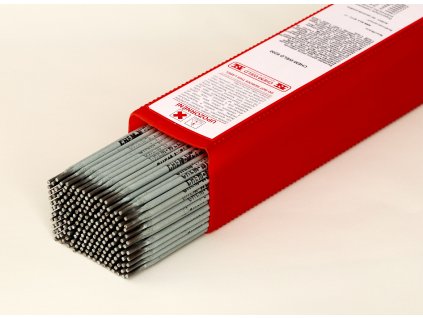
Electrode for repair of cast iron castings CHEM-WELD 6200
Code: 6200250KS 6200250 6200250KR 6200325KS 6200325 6200325KR Choose variantRelated products



Product detailed description
CHEM-WELD 6200
Electrode for cold welding of new cast iron
Electrode suitable for welding and repairing new cast iron and for welding cast iron to steel, for grey and tempered cast iron, for steel to steel and copper and copper alloyed cast iron.
- for the removal of defects after casting
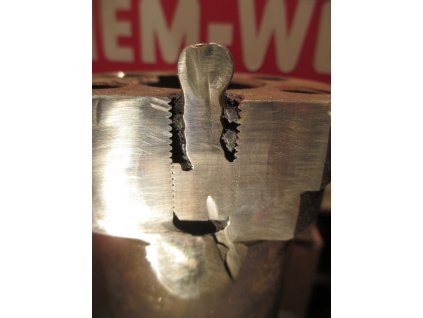
- for welding out badly drilled holes
The welds can be further processed, e.g. by grinding.
The colour of the weld metal is identical to the base material.
When welding grey cast iron, 3 basic rules must be observed:
Welding should only be carried out in short caterpillars
 1 to 3 cm - the length of the caterpillar should approximately correspond to the thickness of the part to be welded.
2. Immediately after welding, hammer (tool) with a round (blunt) nose
 - never with a sharp tool
3. Interpass temperature
  - place the next caterpillar when you keep your bare hand on the weld
ADVANTAGES
welding without preheating
also suitable for transformer
transition
DISADVANTAGES
does not have
When welding cast iron, it is necessary to follow the technological procedure.
SPECIFICATIONS
|
CHEM-WELD 6200 Electrode for cold welding of new cast iron |
|||||||||
|
DIN 8573: E Ni Fe-1-BG13 AWS A 5.15: E Ni Fe-Cl EN ISO 1071: ECNiFe-Cl3 Packaging: rutile-basic Welding current:~40V/=+ Welding position: PA, PB, PC, PD, PE, PF, PG |
Electrode for repairs on new cast iron, for welds to be further worked, for welding ductile iron with steel, for grey cast iron, for steel lithium. Fine grinding of transitions on solid cast iron parts is possible. The colour of the weld metal is identical to the base material.Particularly tough and crack resistant. For welding and repairs, for removing casting defects on engine blocks, repairing broken cast iron parts, welding out badly drilled holes, machine housings. Necessary short welds and hammer peening, welding at low currents. |
||||||||
|
Typical chemical composition of weld metal [%]: |
C |
Si |
Mn |
Ni |
Fe |
||||
|
1,0 |
<2,0 |
<1 |
56 |
residue |
|||||
|
Mechanical properties of weld metal: |
Rm [MPa] |
Re [MPa] |
A5 [%] |
Hardness [HB] |
|||||
|
>400 |
350 |
20 |
200 |
||||||
|
Drying: Generally no drying required |
Diameter [mm] |
Length [mm] |
Number [pcs in kg] |
Packing /kg |
Welding. Current [A] |
||||
|
2,50 |
350 |
49 |
5,0 |
50-80 |
|||||
|
3,25 |
350 |
30 |
5,0 |
70-110 |
|||||
|
4,00 |
350 |
21 |
5,0 |
90-130 |
|||||
Additional parameters
| Category: | CAST IRON |
|---|---|
| běžná ocel: | běžná ocel |
| litina: | litina |
| ocelolitina: | ocelolitina |
| měď: | Měď |
| různé ocele: | různé ocele k sobě |
| trafo: | na trafo |
| Balení: | ks, kg, krabička |
| Průměr: | 2,50 - 3,25 mm |


Společnost CHEM-WELD byla založena v Rakousku roku 1967 panem Siegfriedem Schweigerem.
Název CHEM-WELD znamená spojení chemie a svařování.
Prvním výrobkem bylo speciální lepidlo na kov Chem-Stahl 1000 HT, které nahrazovalo svařování v dolech JAR.